In no particular order, here are my must-have items for newborn care:
water-proof flannel-lined changing pads - I use these to place under baby and myself when nursing in side-lying position at night. This keeps the bed dry, and the flannel is nice and soft to lie on.
bibs with waterproof backing - These are great for keeping milk off of baby's clothes.
My Brest Friend nursing pillow - It is made of foam for firm support, and buckles in place. It also has lower back support.
burp cloths, prefold diapers, or hand towels - I put these under baby and myself when I am nursing with my nursing pillow using the cradle hold. This keeps my clothes and the pillow dry.
button-up and v-neck shirts, nursing camis - These make nursing easy.
Aden and Anais muslin swaddle blankets - The larger size sold on Amazon has made swaddling easy, and swaddling helps baby keep from startling himself awake. Plus, they grow with baby, so I don't need to keep buying different sizes.
sheet savers - these keep me from having to wash crib sheets all the time when baby spits up or has a diaper leak
sound machine or fan for white/background noise - This helps baby sleep in noisy situations (like when traveling).
Tommee Tippee pacifiers and bottles - so far these are baby's preferred pacifiers and bottles (However we just started bottle feeding and I haven't tried Playtex drop-ins or Dr. Browns yet. So far we've ruled out the Medela bottles I purchased, because even the slow flow nipples are much too fast.)
bottle drying rack - The one we have looks like grass, and you can purchase little trees and flowers to place on it as structures on which to hang tiny bottle parts. We got ours at Target. I like it because it's a special, extra clean place to dry all of the tiny bottle and breast pump parts.
Medela steam sterilizing bags - These are great for sterilizing things when you're in a hurry. I use them for pump parts if I know I'm going to have to pump again later in the same day, instead of painstakingly washing each tiny pump part.
Medela breast milk storage bags - You can pump directly into them (provided you have a Medela pump) - very convenient.
Grovia Magic Stick - This is a cloth diaper safe diaper rash cream that comes in stick form. This makes it super fast and easy to apply to baby's bum.
baby washcloths - I probably have about a hundred of these for use as cloth wipes. Regular baby wipes break out my baby's bum, so I just use these instead with plain water. I also use them for wiping away spit-up, and for baths, of course.
Prince Lionheart cloth wipes warmer - I just keep water in this and dunk my cloth wipes in. The warm wipes keep baby much calmer during changes.
Fischer Price snug-a-bunny swing - This will get baby to sleep when nothing else will.
Infantino play mat - It has lots of bright colors and interesting toys, and a mobile that my baby loves. It also makes a great surface for tummy time, and is easy to take out and put away.
pacifier clips - These keep that precious paci from hitting the ground. The last thing you want to do is stop to wash off a pacifier when your baby is screaming.
Planetwise wet bags - I use these instead of having a diaper pail. I have two of the large size that I alternate using while the other is in the wash. I hang one on the back of the nursery door by our changing table. All of my cloth diapers and wipes go inside, and I dump the whole thing in the wash - easy as pie! Also, I just leave it unzipped so that air circulates inside and the diapers don't stink at all. I also have two of the medium size and one small bag for use in my diaper bag.
Motherlove nipple cream - This has absolutely saved my nipples from drying and cracking, and has significantly reduced my pain.
Mylacon and Gripe Water - Our baby is gassy, and these medicines have really helped.
no-scratch mittens - I've never had a problem with these falling off like people kept warning me about. They stay on our baby's hands just fine, and keep him from scratching his face. I ordered a pack from Amazon that are a bit larger, so even though he is a month old right now, he can still spread his hands out inside them.
gowns and zip-up sleepers - These make for quick and easy nighttime diaper changes.
Tuesday, September 30, 2014

Sunday, September 7, 2014
Things I've Learned After Being a Mom for 10 Days
- If you are cloth diapering, and plan to use cloth wipes as well, then baby washcloths make great cloth wipes. In fact, I use them for a ton of other things as well - baths, of course, and wiping baby's face, even as a makeshift breast pad in a pinch. I use them so much that I went out and doubled my stash when I caught some on sale.
- Don't be surprised if your baby never fits into newborn size clothes and/or diapers. At nine pounds one ounce, our bundle of joy went straight to size 1-3 months. Luckily, I was warned about this, and so didn't have much newborn stuff to begin with. Bring a newborn size and a 1-3 month size outfit to the hospital, just in case you have a big baby!
- If your baby is crying but just ate, has a clean diaper, and isn't sleepy, try feeding him/her again. Our little man went through his 1-3 week growth spurt a few days ago, and I felt like all I did was feed him. Every hour, day or night, he would want to be fed. By the time I would feed, burp, and change him, he would be ready to be fed again. I was worried about it at the time, but after a few days of this (and a great weigh in at the doctor's office), things settled down and he was sleeping through the night with only one midnight feeding, and wanting to feed every two to three hours during the day.
- Stick it out if you're breastfeeding. The baby's latch will get better, and you will work out the kinks. Google and your local lactation consultant are your friends. I had oversupply issues, and a Google search led me to try block feeding, which seems to be working so far.
- Your baby's fingernails are sharp, even after you file them down really well. It looks silly, but put socks over his/her little hands to keep scratches from happening. I recently found a pair of hand-me-down baby mittens in my son's sock drawer and gave them a try. I didn't buy any because I read everywhere that they just fall off. Well, I love the ones I have. They stay on great and don't leave sock fuzz all over his little fingers. I plan on buying some more next time I go to the store.
- Breast pads - you will need a ton of them.
- Nursing tanks are awesome; get some.
- If you are breastfeeding, get lots of cloth bibs with a plastic backing. They absorb breast milk, but don't let it soak through to baby's clothes.
- For postpartum recovery, stock up on comfortable pads, Tucks pads, hemorrhoid cream, and A+D Cream.
Tuesday, July 17, 2012
How to Teach English in South Korea
I wrote this in response to a message on Couchsurfing.com, and thought I'd post it here in case anyone else finds it useful:
Hi David,
South Korea is a great place to teach English. The cost of living is low outside of Seoul, and the jobs are plentiful and pay the highest in Asia. You'll need a bachelor's degree in any subject, and you'll also need to get a special visa for English teachers. To do that, you'll have to get a notarized FBI background check, and then get it apostilled by the State department. You'll also need to get your diploma (we ordered extra ones from our university) apostilled by your state's secretary of state. Then you have to submit all of the documents to the nearest South Korean consulate, and have a brief interview with an official. Of course, you'll also need a valid passport.
Actually getting a job in South Korea is fairly easy, if you go the hagwon (after-school academy) route. Just check to make sure that the hagwon is a reputable one, and insist on speaking with a current foreign teacher. Realize that they may sugar coat everything about the school, because they want someone to be hired (or else they will have to fill in for those classes until someone is hired).
Jobs in Korea typically pay for your flight there and back, and you get an extra month's salary at the end as a bonus. As an American citizen, you'll also get all of your taxes back, which will equal about another month's pay. The school should pay 50% of the cost for your nationalized health insurance. Housing is often provided by the school, or you should be given a housing allowance. Now, it'll usually just be a small one-room studio apartment, but in all probability you won't spend much time there anyway. Ask for pictures to make sure the apartment is livable.
Dave's ESL Cafe is the best site to quickly find a job in Korea.
Pusanweb is a good site for finding jobs in Busan (a city that I highly recommend).
Koreabridge and Waygook are two other good sites.
For which schools to avoid, try the Hagwon Blacklist and the Korean Black List.
It might be a good idea to use a recruiter, as you can tell them exactly what kind of job you're looking for, and they can find it for you. Just realize that all recruiters are paid commission for each teacher they place, so they may not have your best interests in mind. Take everything they say with a grain of salt, and really check into your school. We taught at a hagwon in Busan, and had a good experience. However we also know plenty of teachers who got burned by their hagwons. Also, don't take a job where you have to work Saturdays (you can find something better), and stay away from huge chains. They typically don't treat their teachers well.
If you're careful about which job you take, you can have a really great experience in Korea and save up a lot of money. I know I've used many words of caution in this message, but my husband and I had a great experience and plan to return to Korea as soon as we can. It's just that we also heard plenty of stories about shady hagwons that jilted their teachers. The best jobs are *usually* public school jobs, so try to get one of those if you can. It might be tough as the program has been drastically cut. There should be more in-depth information on the forums of the websites I've linked you to. I hope I didn't overwhelm you with all of this information!
Good luck, and feel free to message me with any more questions.
Brandi
Hi David,
South Korea is a great place to teach English. The cost of living is low outside of Seoul, and the jobs are plentiful and pay the highest in Asia. You'll need a bachelor's degree in any subject, and you'll also need to get a special visa for English teachers. To do that, you'll have to get a notarized FBI background check, and then get it apostilled by the State department. You'll also need to get your diploma (we ordered extra ones from our university) apostilled by your state's secretary of state. Then you have to submit all of the documents to the nearest South Korean consulate, and have a brief interview with an official. Of course, you'll also need a valid passport.
Actually getting a job in South Korea is fairly easy, if you go the hagwon (after-school academy) route. Just check to make sure that the hagwon is a reputable one, and insist on speaking with a current foreign teacher. Realize that they may sugar coat everything about the school, because they want someone to be hired (or else they will have to fill in for those classes until someone is hired).
Jobs in Korea typically pay for your flight there and back, and you get an extra month's salary at the end as a bonus. As an American citizen, you'll also get all of your taxes back, which will equal about another month's pay. The school should pay 50% of the cost for your nationalized health insurance. Housing is often provided by the school, or you should be given a housing allowance. Now, it'll usually just be a small one-room studio apartment, but in all probability you won't spend much time there anyway. Ask for pictures to make sure the apartment is livable.
Dave's ESL Cafe is the best site to quickly find a job in Korea.
Pusanweb is a good site for finding jobs in Busan (a city that I highly recommend).
Koreabridge and Waygook are two other good sites.
For which schools to avoid, try the Hagwon Blacklist and the Korean Black List.
It might be a good idea to use a recruiter, as you can tell them exactly what kind of job you're looking for, and they can find it for you. Just realize that all recruiters are paid commission for each teacher they place, so they may not have your best interests in mind. Take everything they say with a grain of salt, and really check into your school. We taught at a hagwon in Busan, and had a good experience. However we also know plenty of teachers who got burned by their hagwons. Also, don't take a job where you have to work Saturdays (you can find something better), and stay away from huge chains. They typically don't treat their teachers well.
If you're careful about which job you take, you can have a really great experience in Korea and save up a lot of money. I know I've used many words of caution in this message, but my husband and I had a great experience and plan to return to Korea as soon as we can. It's just that we also heard plenty of stories about shady hagwons that jilted their teachers. The best jobs are *usually* public school jobs, so try to get one of those if you can. It might be tough as the program has been drastically cut. There should be more in-depth information on the forums of the websites I've linked you to. I hope I didn't overwhelm you with all of this information!
Good luck, and feel free to message me with any more questions.
Brandi
Sunday, June 24, 2012
Making Kimchi
If you like Korean food, and you haven't been to maangchi.com yet, do your self a favor and take a look. Maangchi has great recipes for all kinds of Korean food. I've tried several, and they've all been good so far. Today, I decided to try making some kimchi! I made mak kimchi (the kind that is cut into pieces vs. whole cabbage. It turned out pretty well. Here are some pictures from my attempt:
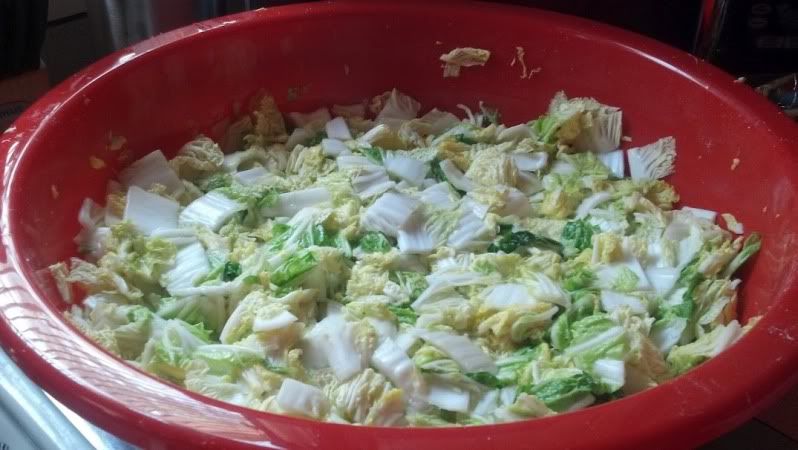
First, I salted the Nappa cabbage.

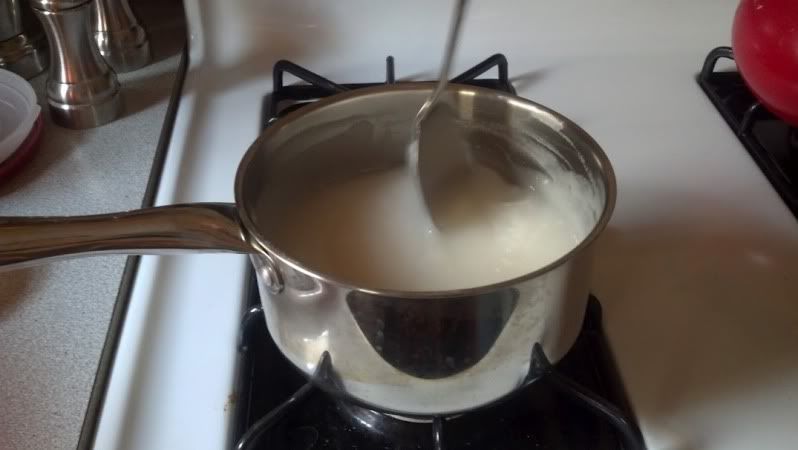
Next, I made the sweet rice porridge:

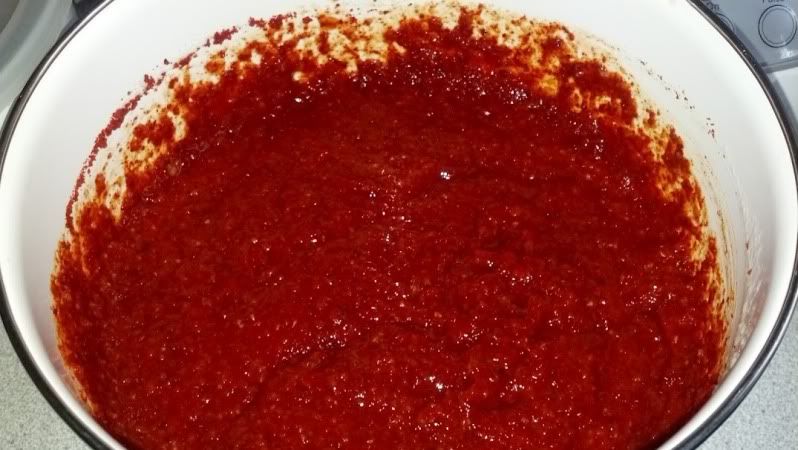
Then, I made the sauce and mixed in the rice porridge:

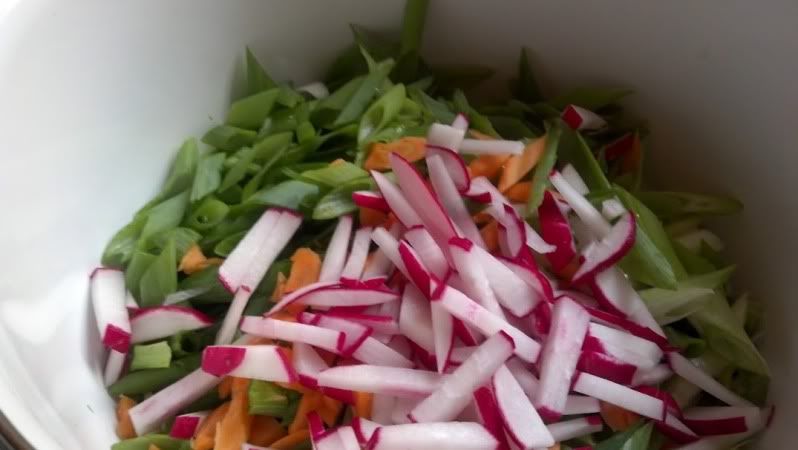
After that, I chopped the veggies:

Next, I mixed the sauce and veggies:

Then, I rinsed the cabbage:

Finally, I mixed it all up!

And ate some for dinner, yum!

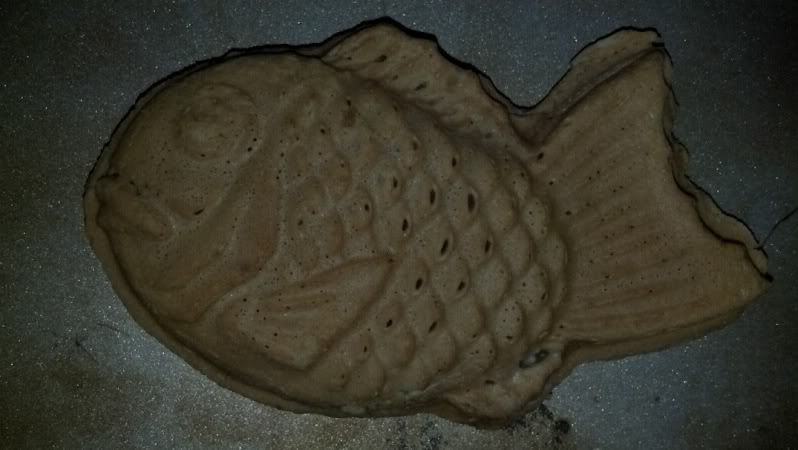
We even had some boongabang (뿡아빵) for dessert!

The kimchi turned out well. However, make sure not to put in more onion than Maangchi advises. I found out the hard way that too much onion will make the kimchi a little bitter.
Here's here recipe; I omitted the squid. Delicious!
First, I salted the Nappa cabbage.
Next, I made the sweet rice porridge:
Then, I made the sauce and mixed in the rice porridge:
After that, I chopped the veggies:
Next, I mixed the sauce and veggies:
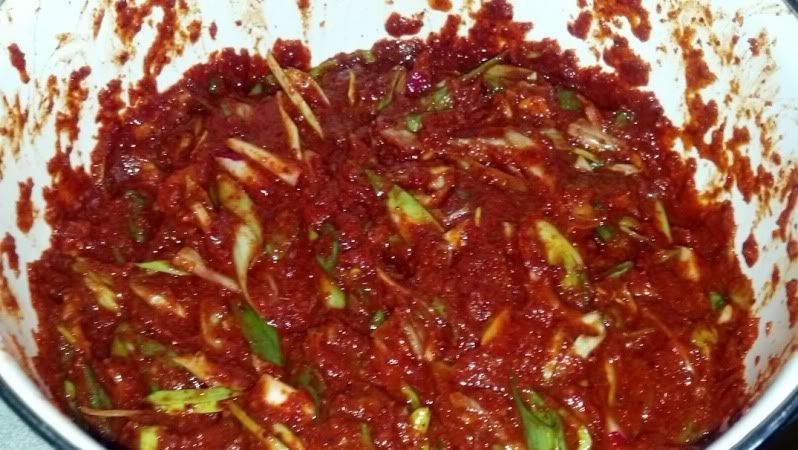
Then, I rinsed the cabbage:
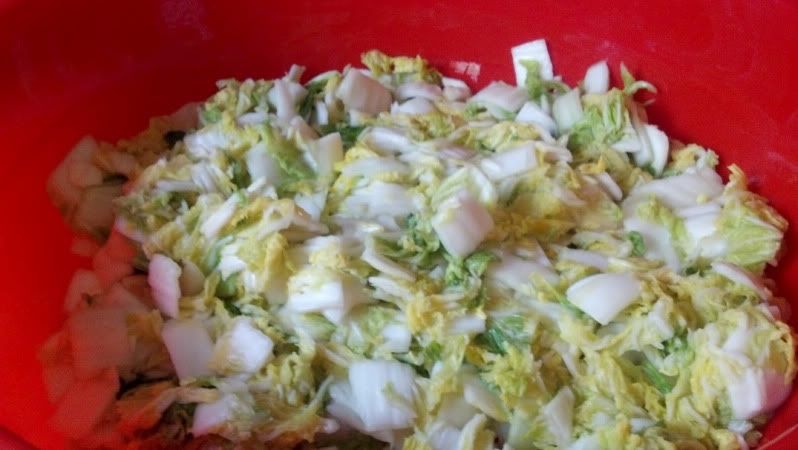
Finally, I mixed it all up!
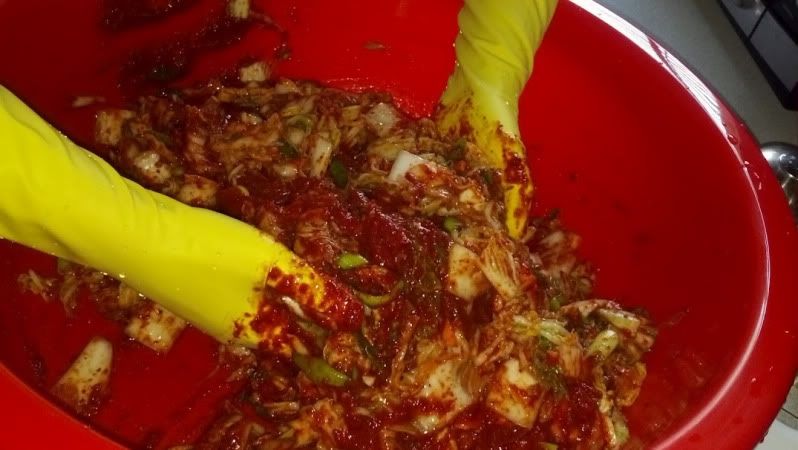
And ate some for dinner, yum!
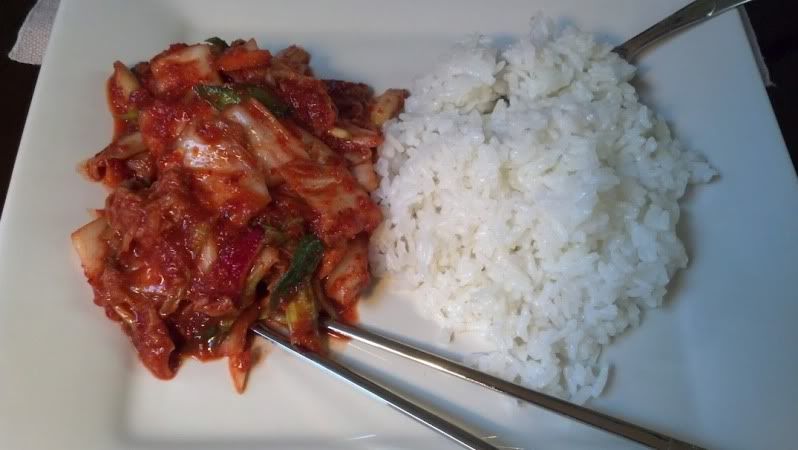
We even had some boongabang (뿡아빵) for dessert!
The kimchi turned out well. However, make sure not to put in more onion than Maangchi advises. I found out the hard way that too much onion will make the kimchi a little bitter.
Here's here recipe; I omitted the squid. Delicious!
Friday, November 11, 2011
Bubble Tea!
I really enjoy bubble tea, but it isn't available in my small town. Last time I was in a major city, I picked up a couple of bags of tapioca pearls, so that I could make bubble tea at home. The package didn't come with any cooking instructions, and information online is limited. But after some trial and error, I think I've got the process figured out.


Friday, August 12, 2011
I miss Korea.
... there, I said it. All I thought about while I was in Korea was getting back home, but now that I'm here, I realize how much I took for granted in Busan. There was no need to own a car, because there was a great subway system, not to mention buses and taxis everywhere. The beach was a short subway ride away, and mountains were everywhere you looked. Downtown was bustling with coffee shops, boutiques, noraebongs (karaoke rooms), great restaurants, pubs and bars, and an endless supply of things to do. The food in Korea is amazing and healthy, and it's CHEAP. Teaching Korean students was both interesting and fulfilling, as Korean students are much more well behaved than American students. The pay was great. There was a whole new culture to learn about, and a close-knit foreigner culture to belong to.
Yes, living abroad is challenging, especially in a country where you really look like an outsider. There are stares, a language barrier, people who are always going to treat you like a second class citizen (because, well, you aren't a citizen). The apartments are small, but in my opinion that's also a plus because there's less to clean. The same could be said for not having a yard. There is smog. It's crowded. Teaching children means you'll get sick often, at least for the first few years. It's definitely different in the extreme from a suburban life in Texas.
But it's also definitely not humdrum. There's a lot to be said for a job and lifestyle that is both fulfilling and financially rewarding. To anyone considering teaching English in South Korea, I'd say go for it. But be ready to roll with the punches, and be ready to be homesick and okay with it.
Yes, living abroad is challenging, especially in a country where you really look like an outsider. There are stares, a language barrier, people who are always going to treat you like a second class citizen (because, well, you aren't a citizen). The apartments are small, but in my opinion that's also a plus because there's less to clean. The same could be said for not having a yard. There is smog. It's crowded. Teaching children means you'll get sick often, at least for the first few years. It's definitely different in the extreme from a suburban life in Texas.
But it's also definitely not humdrum. There's a lot to be said for a job and lifestyle that is both fulfilling and financially rewarding. To anyone considering teaching English in South Korea, I'd say go for it. But be ready to roll with the punches, and be ready to be homesick and okay with it.
Tuesday, November 9, 2010
How to Cure and Season a Molcajete
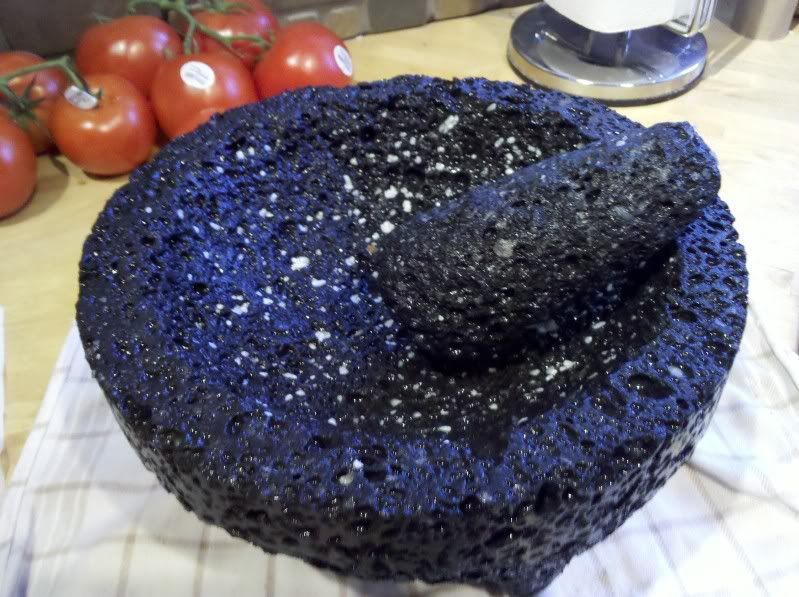
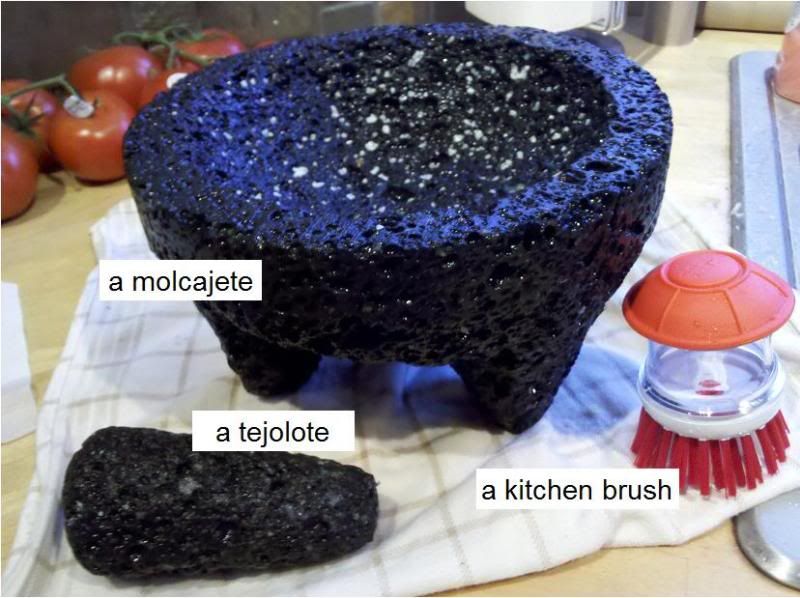
I recently got a molcajete from my husband as an early holiday gift, and I’m really excited about it. What is a molcajete you ask? It’s a three-legged Mexican mortar and pestle made from basalt. They work really well, because the rock is so porous that it makes a great grinding surface. They are also very durable; they are traditionally handed down from mother to daughter through the generations. Another great thing about the molcajete is that it is so porous it tends to absorb the flavor of whatever you make in it, so it becomes seasoned over time like a cast iron skillet. Salsas, guacamole, and mole are all traditionally made in the molcajete. The grinding action breaks apart the seeds in tomatoes and peppers, releasing essential oils and making your salsas taste amazing. Molcajete’s are great for grinding spices as well.
So you want a molcajete? First, make sure that you order a good one. Many suppliers sell molcajetes that are just pressed concrete textured to look like basalt, or other imitation materials. These molcajetes can never be cured properly, and will always leave your salsas full of grit. I ordered the highest quality one I could find from Amazon for around fifty bucks: the RSVP Endurance Molcajete made from natural basalt. They didn’t lie when they advertised that this thing is made to last. It’s certainly difficult enough to cure and season! But the effort is definitely worth it once it’s accomplished.
A molcajete has to be cured before use by wearing down the inside of the stone bowl a bit, so that when you grind food up inside of it grit won’t break off and ruin your food. After it is cured, it can be properly seasoned to start you off making delicious salsas and guacamole. After much research and some trial and error, I’ve come up with what I think is a pretty full-proof way to cure and season a good, sturdy molcajete.
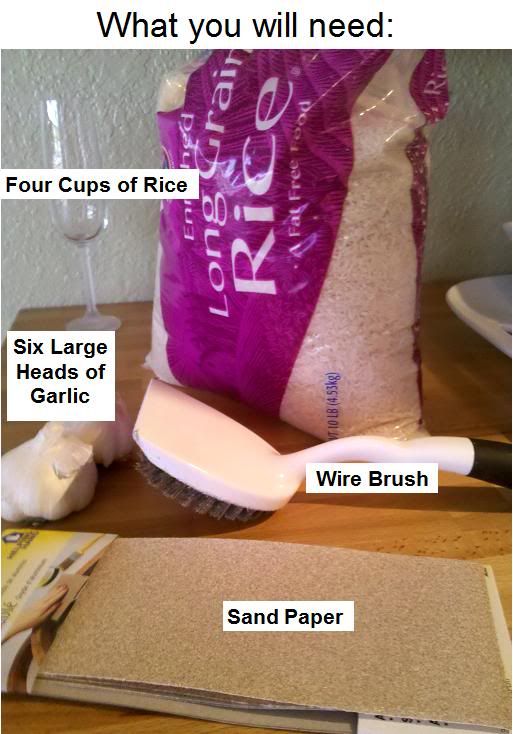
First, fill your molcajete with water and let soak for an hour to make the stone easier to grind down.
Second, take your wire brush and your molcajete outside if possible, and vigorously brush the inside of the molcajete bowl for thirty minutes. This replaces hours and hours of grinding with rice. Then grab your water hose and, either with your thumb or an attachment, use high water pressure to thoroughly spray out all of the grit that has accumulated in the molcajete.
Third, use coarse sand paper to further wear down the bowl of the molcajete, and to scrape off some of the metal from the wire brush that will inevitably coat the surface of the bowl. I sanded mine for about ten minutes; it doesn’t take long for the sand paper to be used up against such a hard surface. After that, wash out the molcajete with your water hose again.
Fourth, put a cup of rice in your molcajete (which should still be wet from being sprayed down), and use the tejolote to grind it into a powder or paste. It should look like this, or even finer:
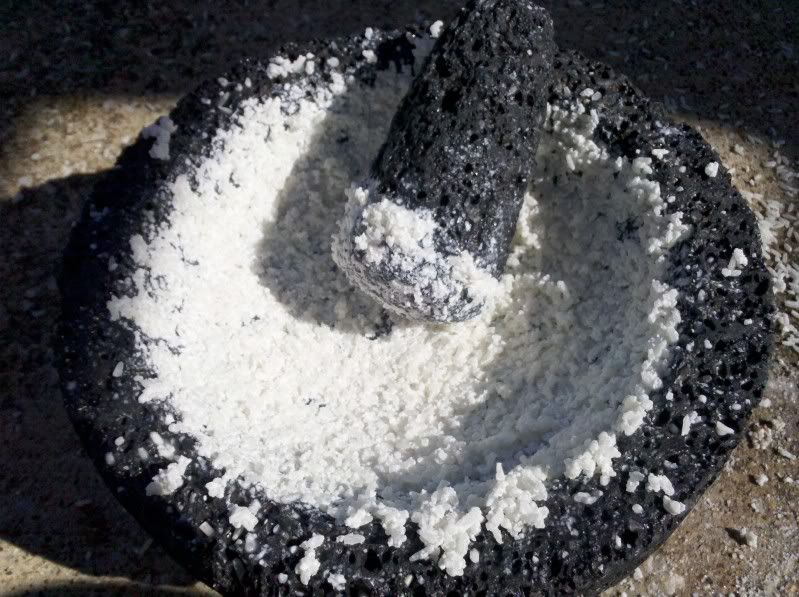
Repeat, this step three more times, or until the rice does not turn gray and contains no grit. Then rinse out the molcajete using the water hose one more time. If there is still some rice wedged into the pores of your molcajete, that is perfectly alright.
Fifth, peel all the cloves from the six heads of garlic, and put them into your molcajete. You can also add a teaspoon of coriander if you like. Grind it all up into a paste, and coat the inside of the bowl with it. Make sure it gets deep into the pores of the molcajete. When finished, it should look like this:
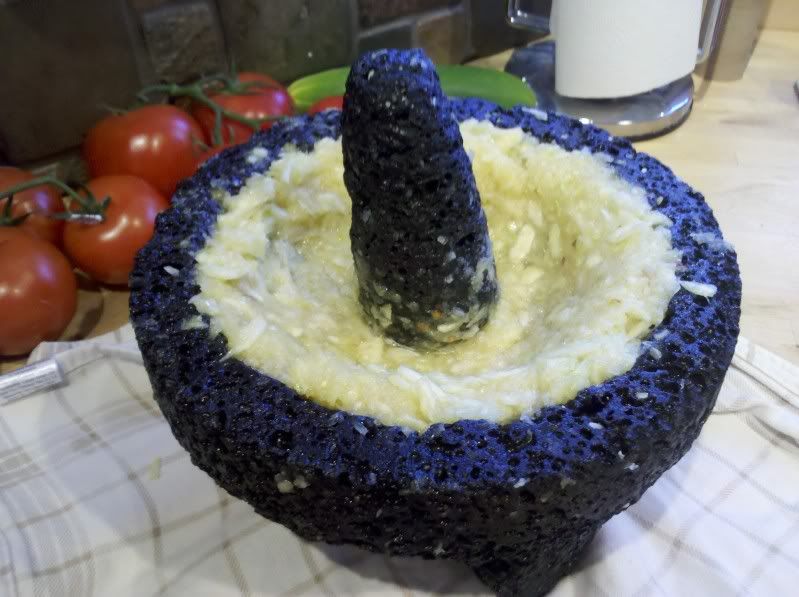
Let the garlic paste sit overnight in the molcajete; this adds oils to the molcajete and seasons it with a good flavor that will add to your salsas and guacamole. The next day, rinse the molcajete out as good as you can with the water hose. Then, bring it inside and use your kitchen brush to brush off the remaining garlic, and rise it off in the sink.
Now your molcajete should be thoroughly cured and seasoned, and ready to make delicious grit free salsa!
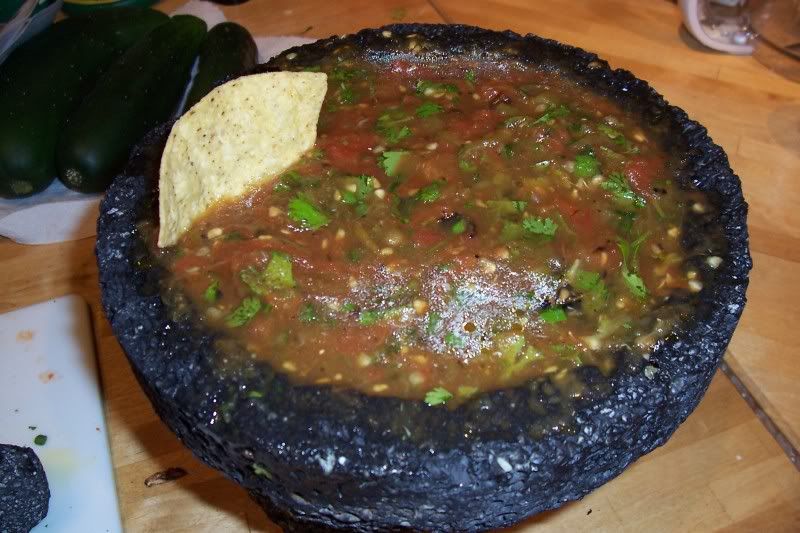
¡Disfrute!
Subscribe to:
Comments (Atom)